

INTRODUCTION
West of the Waterberg Plateau Park, vast plains are occasionally broken by remnants of ancient Sandstone outcrops, which once covered large areas of northern Namibia.
Nestled among the “Omboroko Mountains” lies OKONJIMA – a Herero name meaning “Place of the baboons”. This is much more than just a lodge. OKONJIMA is also home to THE AFRICAT FOUNDATION.
AFRICAT became internationally renowned after featuring in an award-winning documentary filmed for the Discovery Channel in 1995 & 1996.
The AfriCat Foundation started out in 1992/93, as a small welfare organization when ‘Chinga’ the Cheetah was bought by the Hanssens at a cattle auction and given a home on Okonjima.
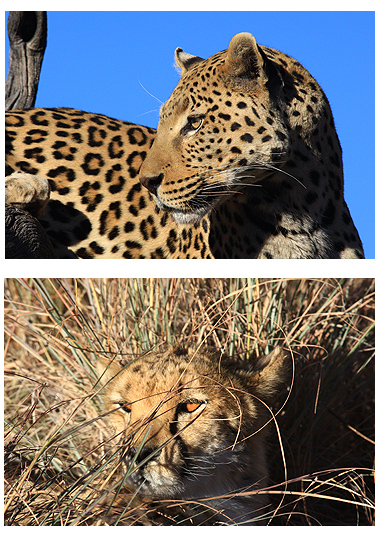
Ever since, AfriCat and Okonjima have dedicated their efforts to rescuing carnivores from inhumane conditions, taken care of those too injured to be set free, rehabilitated and released more than 1000 large carnivores back into the wild. Today, AfriCat’s emphasis lies with ensuring the long term survival of Namibia’s large carnivore species through Environmental Education, Research & Mitigating Human-Wildlife Conflict, thereby contributing to habitat & wildlife conservation as well as uplifting affected farming communities.
Namibia is home to the world’s largest wild/free-ranging cheetah population; the majority of this country’s cheetahs and leopards can be found on approximately 7000 commercial farms. These large carnivores occasionally prey upon the livestock that roam unprotected in the bush. As a result, carnivores are often regarded as vermin by the livestock and game-farming community and are deliberately trapped and/or killed.
AFRICAT has had to take on a large number of captive cats / carnivores no longer wanted by other establishments. Among the carnivores being rescued, researched and rehabilitated by AFRICAT are cheetah, leopard, lion, caracal, wild dog and hyena.
OKONJIMA is a family-run business. Wayne, Donna and Rosalea Hanssen who co-own and live on the property, bought OKONJIMA from their parents, Val and Rose, in 1993, turning the then cattle farm into a conservation project.
The pressure on our wildlife grows daily. Where today can one find a truly wild place? Where can the elephant roam, the lion roar, the cheetah hunt? Through Education and Human Wildlife Conflict Mitigation, The AfriCat Foundation believes that little by little the battle can be won.
AFRICAT has saved more than a 1000 carnivores since 1993. 86% have been released back into the wild!

 ROGERS BIRD FACT
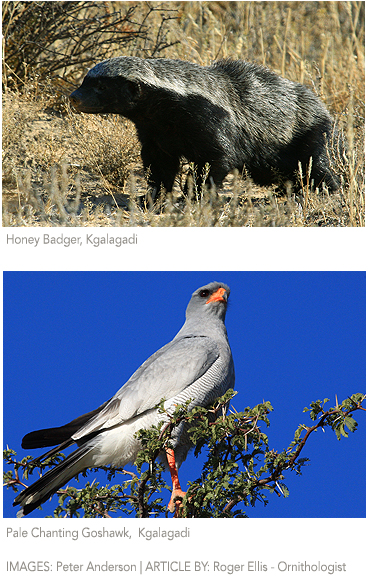
Honey Badger & Pale Chanting Goshawk
(Mellivora capensis & Melierax canorus)
How the Pale Chanting Goshawk takes advantage of the power of a Honey Badger.
In the Kalahari desert, a place where these creatures are fairly common, the Goshawk has learnt to use the physical strength of the badger to its advantage.
When the Honey Badgers are out hunting, which is a great deal of the time, they are often forced to dig prey (like Gerbils) out of burrows. The Goshawk cannot do this, so they have been seen to land in close proximity to the hunting badger and wait.
Gerbils and some other rodents often live in communities or family units in several adjacent tunnels. On the occassion where the Badger exposes more than one rodent, and they run in different directions to try and escape, the Goshawk can then make easy pickings of this prey.
I personally see this as a bit of a one sided arrangement, as I don’t see any advantage for the Badger. However being a flying creature might in some way warn the Badger of the larger preditors in the area.
Having said that the Badger itself is an extremely capable fighter. On one occassion in the Sabi Sands, I witnessed a Honey Badger that had been severely injured with its spine broken and entrails disemboweled. The animal was still alive and only capable of dragging itself down the road by its front claws. On back tracking to where the animal had come from we had discovered a dead leopard.
DOWNLOAD THE FULL NEWSLETTER HERE